

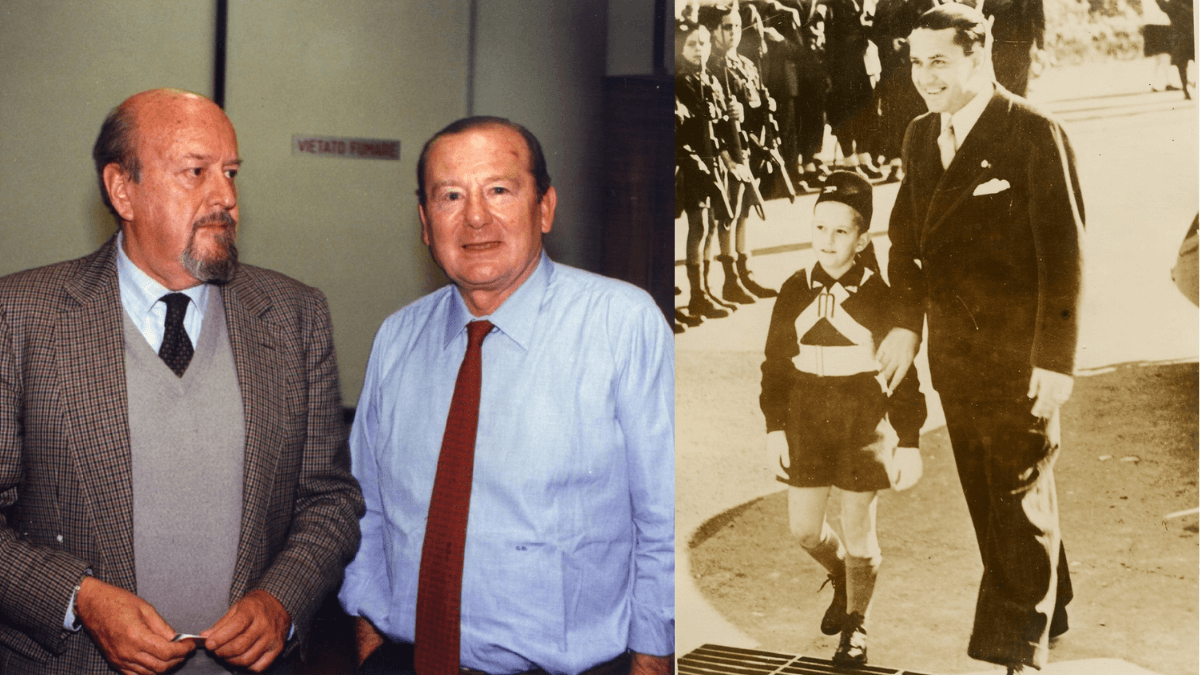
Fabrizio Ciano was born in Shanghai on October 1 1931. He was the son of Galeazzo Ciano and Edda Mussolini. His birth connected him to two influential families within the Italian political elite. His mother, born in 1910, was Benito Mussolini’s eldest daughter, while his father, born in 1903, became a prominent member of the government and Italy’s minister of foreign affairs. Looking at this family history, it is easy to see how Fabrizio’s household was closely linked to the Italian political elite and wider government life.
The direction of that life changed during his early years. The Grand Council meeting in July 1943, followed by the Verona trial and Galeazzo Ciano’s execution in January 1944, marked a serious change for the family. By the time Fabrizio was a teenager, the family axis had begun to rapidly tilt from state grandeur toward exile, uncertainty, and private remembrance. Fabrizio Ciano and his siblings had known both affluence and danger,
while children of this world appeared in photographs from the 1930s, surrounded by the optics of power. Behind those images came legal disintegration, social disintegration, and the gradual decline from sovereign influence to private remembrance. That unavoidable decline became an important part of the family’s history, linking foreign affairs, the trial, execution, 1943, and later memories of a changing political world.
Fabrizio Ciano and the Legacy of His Family Name
For Fabrizio the Ciano name carried history in a way that felt like a folded map, marked by lines, wrinkles, battles and routes that had opened or closed over time. As a Count he inherited a title connected with ranks yet the changing world of republics had made such status more of a marker than a mandate. The name could open doors. Close others, bringing recognition without real power. In my reading of family stories this kind of inherited identity often becomes deeply personal because a family name can carry both pride
and difficult memories across generations. The true weight of the name became clearer through his father, who was executed on 11 January 1944 after the Verona trial. That single date became an axis around which the family narrative and Fabrizio’s later writing developed. His mother, Edda lived until 1995. Preserved household memory, as a private archive shaped by grief and grievance.
Across decades and continents the family name could inspire reverence well as reproach. The old noble ranks, title, execution, trial, memory, archive, writing, and narrative therefore remained connected to the same history, with recognition and power becoming ideas that were more complicated than the name itself.
| Quick Bio | Details |
|---|---|
| Full Name | Fabrizio Ciano |
| Born | October 1, 1931 |
| Birthplace | Shanghai, China |
| Father | Galeazzo Ciano |
| Mother | Edda Mussolini |
| Maternal Grandfather | Benito Mussolini |
| Paternal Grandfather | Costanzo Ciano |
| Siblings | Raimonda Ciano and Marzio Ciano |
| Spouse | Beatriz Uzcategui Jahn |
| Known For | Memoirist and keeper of family history |
| Notable Book | Quando il nonno fece fucilare papà |
| Family Title | Count |
| Public Role | Writer and chronicler of his family’s history |
Career and Literary Voice
Rather than building a political career or business career, Fabrizio became known through a different kind of public life. His memoir, *Quando il nonno fece fucilare papà* published around 1991 stands as his notable contribution to the public record. In it he turned family lore into evidence following the side of a political disaster through a personal narrative shaped by rage, sensitivity and curiosity. The book moves through memory like a map of the streets he knew,
giving the family story a more personal form. His writing transformed personal trauma into a lasting record, making him more a keeper of memory than a public man concerned with political affairs. From a historical perspective, this is a unique accomplishment because a story can preserve experiences that a power structure may leave behind, even when those memories are difficult to reverse or erase.
Family Tree and Key Relatives
The familial network around Fabrizio connects numerous essential figures throughout generations. His father, Galeazzo Ciano, came to be born in 1903 and died in 1944. A diplomat and minister of distant places affairs, he changed into carried out after the Verona trial on eleven January 1944. Fabrizio’s mom, Edda Mussolini Ciano, was born in 1910 and died in 1995 as the eldest daughter of Benito Mussolini, the founder and chief of Fascist Italy. His maternal grandfather turned out to be Benito Mussolini, at the same time as his maternal grandmother,
Rachele Mussolini lived from 1890 to 1979 and became Benito’s wife. On his father’s side, his paternal grandfather, Costanzo Ciano, lived from 1876 to 1939 and turned into an admiral and outstanding Fascist politician. His paternal grandmother, Carolina Pini, turned into the partner of Costanzo, even though her dates are now not widely publicized. Fabrizio’s siblings protected Raimonda Ciano, who lived from 1933 to 1998, and Marzio Ciano,
who lived from 1937 to 1974. They were close kin who lived largely out of the limelight after the battle. Fabrizio’s spouse was Beatriz Uzcategui Jahn, and they were married, with no recorded children. Looking at this family table, the connections form a lattice of power, stories, obligation, and memory. The paternal branch carried naval and political prestige, while the maternal branch carried a supreme level of historical drama, giving Fabrizio’s family background an unusually complex place in history.
Legacy Through Memory and Writing
Fabrizio chose a narrow public lane instead of trying to rehabilitate the politics of his elders through broad public campaigns or build a new public career around his family name. His legacy became both literary and archival, shaped by narrative fragments and family testimony that historians and readers can use when studying a tempestuous period in history. His position remained diffused however persistent, displaying how reminiscence can act as a slow-operating force that enters the report after which the public imagination,
similar to water slowly entering stone. His life shows how an inheritor to electricity can end up a chronicler in place of a ruler. While others used public offices, he used phrases, leaving a literary legacy and archival legacy via circle of relatives, politics, public life, campaigns, profession, testimony, narrative, memory, and imagination in preference to searching to become every other ruler through formal places of work.
FAQs
Who turned into Fabrizio Ciano?
Fabrizio Ciano modified into the son of Galeazzo Ciano and Edda Mussolini. He came from one in all Italy’s most traditionally distinguished political families.
When Fabrizio Ciano was born?
Fabrizio Ciano was born on October 1, 1931, in Shanghai.
Who were Fabrizio Ciano’s dad and mom?
His father changed into Galeazzo Ciano, a diplomat and former Italian overseas minister. His mom is Edda Mussolini, the eldest daughter of Benito Mussolini.
What has Fabrizio Ciano known for?
He became specially regarded for his writing and protection of circle of relatives recollections as opposed to for holding a major political or employer function.
What e-book did Fabrizio Ciano write?
His superb memoir became Quando il nonno fece fucilare papà, posted round 1991. The ebook explored his own family records and the events surrounding his father’s execution.
When Will Galeazzo Ciano be Executed?
Galeazzo Ciano was modified and completed on January eleven, 1944, following the Verona trial.
Was Fabrizio Ciano concerned in politics?
There isn’t always any famous document of Fabrizio building a super political profession. His public contribution became regularly associated with writing and own family data.
